Showing posts with label whales. Show all posts

Monday, March 23, 2009

Stranded whales die amid rescue efforts

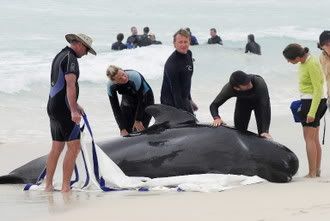
More than 60 whales are dead and 17 remain stranded after beaching themselves on Western Australia's southwest coast.

More than 100 volunteers were desperately trying to keep the animals in a group because if they were sent into the ocean on their own, they could return to beach themselves after hearing the distress calls of other whales.

Mass strandings of long-finned pilot whales on Australian coasts have occurred on average once a year since 1970.

Earlier this month, on King Island, northwest of Tasmania, more than 140 pilot whales died after nearly 200 beached themselves on the coast.

A DEC spokeswoman said what caused the animals to strand themselves was a mystery that would be investigated.

Source

Photo credit: Steve Mitchell, AP
READ MORE - Stranded whales die amid rescue efforts

Sunday, March 22, 2009

Think of the children

Have a whale of a time in the tub!

MOBY is a spout cover that brightens up the bath while keeping baby’s head safe from bumps. Its sleek design includes an adjustable fin strap that fits snugly on most tub spouts, and a tail that’s also a handy hook, so MOBY can hang around when bath time’s done.

$13.00 at Skip Hop
READ MORE - Think of the children

Monday, February 23, 2009

The quest to ave Right whales

At least 32 new right whale calves -- more than ever recorded -- have been observed this season off the coasts of Georgia and Florida, where the whales migrate to give birth between late November and March. Only about 400 members of the species exist, and the massive mammal is thought to be the most endangered of all the large whales.

Each birth is seen as a miracle of sorts -- a potential key to the survival of a species that has been through many tough years.

Right whales were named by their hunters who once said they were the "right whale" to kill. When they were harpooned, the chubby whales floated to the surface of the water. That made them both profitable and easy to hunt.

Every morning during calving season, volunteers armed with binoculars and whale-related handouts troll up and down the Florida coast -- climbing to balconies and zipping up elevators to the top floors of high-rise condos and retirement communities -- to look for whales.

Source
READ MORE - The quest to ave Right whales

Thursday, February 19, 2009

Hello, beautiful!

Meet Inuk, upclose and personal.

Inuk is the Mystic Aquarium's male Beluga whale. He is an amazing creature who shows a great deal of curiosity and intelligence. When the crowds are thin at the Aquarium and there are only a few people in front of the glass he will sometimes stay and watch those people closely. Especially children who are more calm.

Some people ask if whales have ears at the aquarium...here you can see the small opening behind the eye, that's Inuk's ear.

Status: Vulnerable, growing risk; mostly from pollution of native waters but also hunting.

IUCN Redlist: Vulnerable
Cook Inlet Alaska Population: Critically Endangered.

CITES: Appendix 2

Photo & text: eclectic echoes

(via benhästen)
READ MORE - Hello, beautiful!

Thursday, August 28, 2008

A white whale

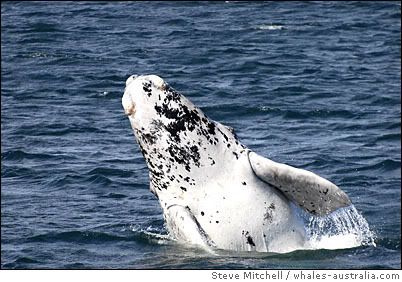
A rare albino Southern Right Whale calf surfaces on West Australia's Flinder's Bay. The calf, believed to be 2 months old, will remain in the bay with its mother for another month while it gains strength and size before making the journey to the Antarctic for summer feeding.
READ MORE - A white whale

Sunday, April 27, 2008

Video: Orcas hunt sea lions

Exhibiting a rare hunting method, some Orcas whales off the coast of Argentina's Valdes Peninsula capture their prey of baby sea lions by approaching the beach and then retreating.


Watch video
READ MORE - Video: Orcas hunt sea lions

Thursday, March 13, 2008

Moko the dolphin is a savior of whales

Moko the dolphin had already won over humans at Mahia Beach, where she plays with swimmers in the New Zealand surf and pushes kayaks along with her snout.

Now the friendly bottle-nosed has shown her empathy for other species, by saving two whales from almost certain death after they became stranded.

Human attempts to guide the two pygmy sperm whales through a narrow escape route from the beach had consistently failed, and all seemed lost until the dolphin intervened.

Moko, a regular visitor to Mahia Beach on the east side of North Island, appeared to communicate with the whales before guiding them to open water.

Source: Times on Line
READ MORE - Moko the dolphin is a savior of whales

Friday, March 7, 2008

Mythic white orca sighted

“With hundreds of killer whales documented around the Aleutian Islands, this was equivalent to finding a needle in a haystack,” said Holly Fearnbach, a research biologist who was able to photograph the whale’s white fin and back.

Scientists aboard the NOAA research vessel Oscar Dyson in the North Pacific have sighted a creature of great rarity and even myth: a white whale.

Source: Alaska Report
READ MORE - Mythic white orca sighted

Monday, January 21, 2008

The Whale Hunt - A Story in 3214 Photos

From May 1 to May 7, Jonathan Harris took a photo every 5 minutes of an Inupiat Whale Hunt near Barrow Alaska.

(via)
READ MORE - The Whale Hunt - A Story in 3214 Photos

Friday, November 30, 2007

Name the baby beluga

You are invited to vote on and submit name suggestions for the Shedd Aquarium's name-needing baby beluga.

Born on Aug. 16, 2007, the beluga calf is the fourth successful beluga birth at Shedd. The proud parents are the 24-year-old female beluga, Mauyak, and the 21-year-old male beluga whale, Naluark. The Shedd Aquarium is one of nine North American zoos and aquariums committed to public display and breeding of beluga whales.

Names can be submitted to and voted on at NBC5.com/babybeluga from Nov. 29 to Dec. 9. Then, the top five names will be determined, and viewers will be able to vote on the final name from Dec. 10 to Dec. 19. Click here for official rules.
READ MORE - Name the baby beluga

Friday, November 9, 2007

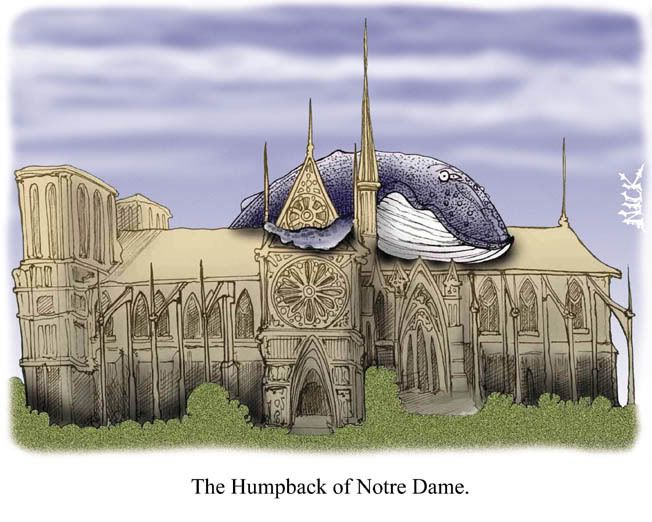
The Humpback of Notre Dame

READ MORE - The Humpback of Notre Dame

Monday, August 6, 2007

Beluga whales under threat

Summer doesn't last long on the edge of the Arctic circle, but on the remote Solovetsky Island on Russia's White Sea it marks the remarkable return every year of Beluga whales just metres from the shore.

Scientists say it is the only place in the world where the whales come so close. Like many whales worldwide, these belugas are threatened - not by hunting but by the quest for energy and people's gradual encroachment on their habitat through shipping.

The whales come most days in good weather. Highly gregarious, the adult white mammals frolic and twist together with their calves, sometimes in schools of 50, lazily breaking the surface with their long backs, before diving underwater again at a location now known as Beluga Cape.

Described by environmentalists as one of Russia's national treasures, the beluga - which resemble large dolphins - will be fighting for survival as the Arctic develops and shipping, energy projects and pollution threaten their natural habitat.
READ MORE - Beluga whales under threat

Tuesday, July 3, 2007

Rare white humpback whale spotted


Record numbers of humpback whales are on their annual migration up Australia's east coast, including the rare white whale Migaloo, scientists say.

Migaloo, whose Aboriginal name means "white fella", is believed to be the only completely white humpback whale in the world.

The 14-metre whale was spotted off Heron Island, on Queensland's central coast, by resort staff on a fishing trip.

(via)
READ MORE - Rare white humpback whale spotted

Monday, May 21, 2007

Mexican baby whale in tug of love

A newborn killer whale found bleeding on a Mexican beach has become the centre of an international controversy over whether she should stay in Mexico or be sent to a U.S. marine theme park.

Her caretakers say there is no tank in Mexico big enough to keep her when she grows and she will die if put back in the sea or kept in an aquarium that is too small for her.

Some environmentalists oppose transferring Pascuala to Sea World, however, because it could set a precedent that might enable animal traffickers to export more killer whales, also known as orcas.

"It hurts us that this animal might die, but we cannot set a negative precedent," said Alejandro Olivera, head of ocean campaigns for Greenpeace in Mexico.

The Mexican government's environmental protection agency has so far blocked a transfer to San Diego, saying Mexico's wildlife should not leave the country.
READ MORE - Mexican baby whale in tug of love

Wednesday, May 16, 2007

2 whales swim up Sacramento River

A pair of wayward humpback whales continued their improbable odyssey Tuesday, swimming to the outskirts of the state capital.

The whales eluded marine biologists and law enforcement patrols who had searched for them throughout the day but were spotted Tuesday evening by a helicopter pilot for KCRA-TV in the deep water shipping channel south of Sacramento.

Footage showed the whales — believed to be a mother and her calf — plying the canal about two miles south of the Port of Sacramento. They were headed upriver toward the turning basin used for deep-water ships, a journey of more than 50 miles from the point where the Sacramento and San Joaquin rivers merge at Suisun Bay.

While it's unusual for whales to reach so far into the delta, it is not the first time. In 1985, a humpback nicknamed Humphrey was escorted back to sea after swimming in the delta for nearly a month. He returned to San Francisco Bay five years later.
READ MORE - 2 whales swim up Sacramento River

Wednesday, April 18, 2007

Young Whale Found in New York Harbor

Marine biologists were standing watch on Tuesday over a young whale that lost its way in New York harbor and nearly wandered into a narrow waterway notorious for industrial pollution.

The animal, described as a juvenile minke whale about 15 feet long, was cruising around Gowanus Bay, the outlet from the mile-long Gowanus Canal in Brooklyn. It appeared to be in good health and not distressed, said Kim Durham, rescue program director for the Riverhead Foundation for Marine Research and Preservation.

The foundation, based in Riverhead, N.Y., specializes in cases involving whales, dolphins, seals and sea turtles.

Durham and other experts were dispatched to the scene after the whale was spotted early Tuesday. A television news helicopter videotaped it leaping out of the water, a behavioral trait common to whales of the baleen species.

UPDATE: 4/19/2007

NYC Whale Beaches Itself, Dies Suddenly

A young whale that swam aimlessly for two days in a small bay off an industrial section of Brooklyn beached itself at an oil depot dock Wednesday and died suddenly. Animal activists said the minke whale, about a year old, was too young to survive on its own.

"It's very sad," said Kim Durham, a rescue specialist at the Long Island-based Riverhead Foundation for Research and Preservation, who had monitored the troubled animal's activities around the clock. "It was a very young whale that became confused and disoriented."
READ MORE - Young Whale Found in New York Harbor

Thursday, April 12, 2007

Marine Scientists Monitor Longest Mammal Migration

Marine scientists recently published a research paper in the science journal, biology letters, that found humpback whales migrate over 5,100 miles from Central America to their feeding grounds off Antarctica; a record distance undertaken by any mammal.

"For years everyone said humpback whales could be found in warmer waters during the winter months, but this was the first time we were actually able to quantify this on a global scale, and relate it to these long distance migrations."
READ MORE - Marine Scientists Monitor Longest Mammal Migration

Wednesday, March 14, 2007

Jumbo Squid, Sperm Whale Study Reveals How the Giant Creatures Feed, Hunt

For the first time ever, researchers have electronically tagged sperm whales and jumbo squid swimming together off Mexico's Pacific Coast to learn more about how the giant creatures hunt and feed.

It's probably the only time tracking devices have been applied simultaneously in the same waters to deep-diving predators and their prey.
READ MORE - Jumbo Squid, Sperm Whale Study Reveals How the Giant Creatures Feed, Hunt

Friday, March 9, 2007

The Secret Language of Whales Revealed

Deep below the ocean's surface, blue whales are singing, and for the first time, scientists think they know why. Researchers from the Scripps Institution of Oceanography recorded the sounds and say they offer new insight into the behavior of the passenger jet-sized animals.

Using tags suctioned to the whales' bodies, researchers tracked the whales and found that as they feed, they send out calls to let each other know where they are, each group employing a different sound.

The noises play a similarly important role during mating season when males sing long, low-pitched songs to indicate their reproductive fitness to females. Females select mates based on size and estimate that by evaluating males' songs: Larger males can take in more air and hold notes longer.

The research appears in the January 25 issue of the Marine Ecology Progress Series journal.
READ MORE - The Secret Language of Whales Revealed