
Showing posts with label butterflies. Show all posts
Showing posts with label butterflies. Show all posts
Wednesday, December 17, 2008

Monday, October 6, 2008

Monday, September 29, 2008
Unexpected transformations
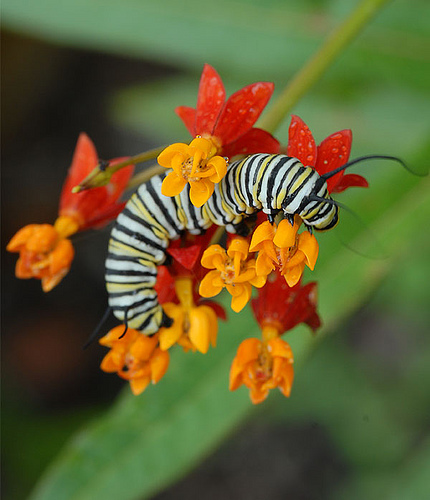 "There once was an ugly duckling," goes the old song. This could not be more true of these stunning butterflies and their most peculiar caterpillars. Another opportunity to scratch your head at the vagaries of Mother Nature, take a look at this pictorial proof of butterfly beauty and caterpillar creepiness!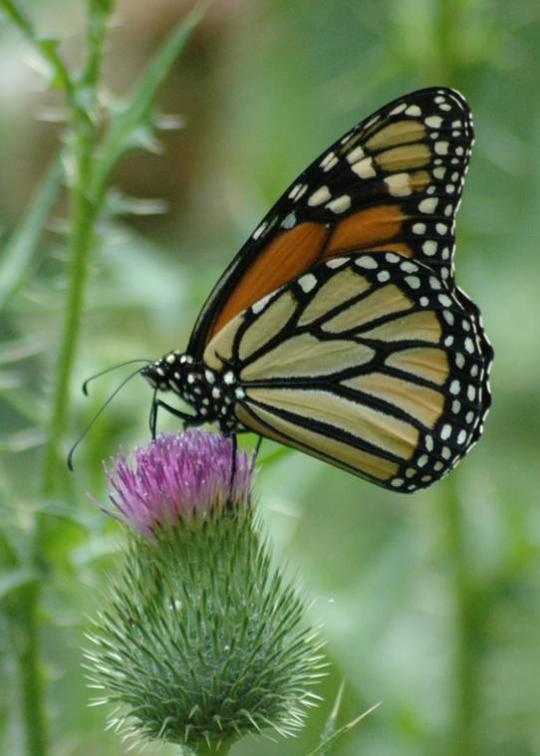
Monday, July 14, 2008
State Insects
The Smithsonian has compiled a list of the 41 states in the United States which have officially designated State Insects.
Illinois has the Monarch Butterfly:
Most of the states who have an official State Insect have selected a butterfly of some sort, but New Mexico is very unusual.
The State Insect of New Mexico is the Tarantula Hawk Wasp:
Read more about the Tarantula Hawk Wasp at Durango Nature Studies
READ MORE - State Insects
Illinois has the Monarch Butterfly:

Most of the states who have an official State Insect have selected a butterfly of some sort, but New Mexico is very unusual.
The State Insect of New Mexico is the Tarantula Hawk Wasp:

Read more about the Tarantula Hawk Wasp at Durango Nature Studies
Wednesday, October 31, 2007
Auction for the Naming Rights for A New Butterfly Species
 In an apparent first for butterflies, the Florida Museum of Natural History is auctioning the naming rights for a newly discovered species online to raise money for butterfly research.
University of Florida researchers George Austin and Andrew Warren discovered the new species of owl butterfly earlier this year. The discovery is significant because the species is large and colorful, and is the first butterfly from this group to be named in more than 100 years.
Rather than naming the butterfly themselves, the customary practice when new species are discovered, Austin and Warren decided to auction the naming rights of the new species to raise money to support continued research on Mexican butterflies at the McGuire Center.
View Bid Form
Tuesday, September 25, 2007
Bugs can be cute
This is a Spicebush Swallowtail caterpillar. Isn't he cute?

They are bright green with numerous blue spots with thin black outlines. Their eyespots are much bigger, with the black part being kind of shiny. They also have two other secondary fake eye spots that are yellow. The bottom half of their bodies are a sort of pinkish color. Viewed from certain angles they look like a small snake, to help scare off predators.
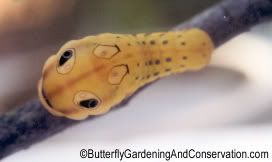
Here's a view of his cute little face.

Before they pupate, Spicebush Swallowtail caterpillars turn a bright yellow color.

This is what the cute little catterpillar grows up to become:
Spicebush Swallowtail - Papilio troilus

The adults have a wingspan of 2.5 - 3.8 inches. Their range is most of the eastern half of the US, except extreme south Florida and Texas.
Source & photos: Butterfly Gardening & Conservation
READ MORE - Bugs can be cute
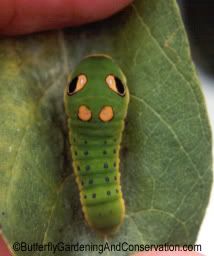
They are bright green with numerous blue spots with thin black outlines. Their eyespots are much bigger, with the black part being kind of shiny. They also have two other secondary fake eye spots that are yellow. The bottom half of their bodies are a sort of pinkish color. Viewed from certain angles they look like a small snake, to help scare off predators.
Here's a view of his cute little face.

Before they pupate, Spicebush Swallowtail caterpillars turn a bright yellow color.
This is what the cute little catterpillar grows up to become:
Spicebush Swallowtail - Papilio troilus
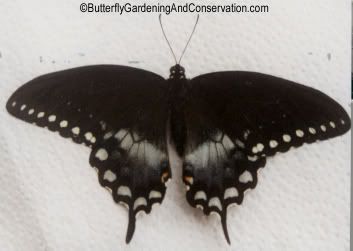
The adults have a wingspan of 2.5 - 3.8 inches. Their range is most of the eastern half of the US, except extreme south Florida and Texas.
Source & photos: Butterfly Gardening & Conservation
Monday, February 26, 2007
Rhapsody in Blue
 For most of the year, the Karner blue butterfly exists as a tiny, dimpled white egg. But as winter days lengthen into spring, the life inside begins to stir, and soon a pale green caterpillar emerges. It feeds, then cloaks itself in a chrysalis. And then, for one brief week, the Karner blue is on the wing.
Or, a wing and a prayer.
For decades, the butterfly with the fleeting appearance was on the verge of becoming a fleeting species as its oak savannas and pine barrens disappeared. Now, with efforts to restore its preferred habitat and raise the butterflies in captivity, the Karner blue’s future is decidedly more upbeat.
The rare blue butterfly lives for the wild blue lupine. When Karner eggs hatch in April, lint-sized caterpillars emerge to feed on the leaves of the newly sprouted plant. Nothing else will do. And when the mature butterflies are looking to lay eggs for a second brood, again, they’ve only got eyes for lupine.
Subscribe to:
Posts (Atom)
