Showing posts with label archeology. Show all posts

Monday, April 4, 2011

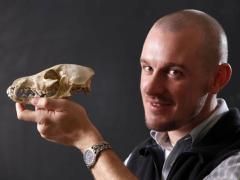
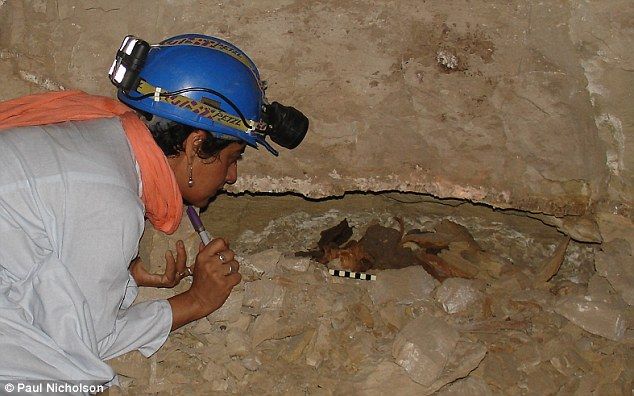
Mummified remains of 8 million dogs excavated in Egypt

A labyrinth of sacred tunnels packed with the mummified remains of millions of dogs has been excavated under the Egyptian desert.

The catacombs are estimated to contain the remains up to eight million dogs, many of which would have been offered to the gods when they were just hours old.

Others would have been treated as living representatives of the dog or jackal-headed god Anubis and would have lived out their lives in the nearby temple before being preserved and laid to rest in the network of tunnels.

The fascinating details come from Cardiff University scientists, who along with Egyptian colleagues are the first to examine the structure and contents of the complex underground network built 2,500 years ago under the Saqqara desert.

The dog catacomb is the larger of two in the area. The Saqqara desert also contains catacombs dedicated to bulls, cows, baboons, ibises, hawks and cats.

Source
READ MORE - Mummified remains of 8 million dogs excavated in Egypt

Wednesday, January 19, 2011

Dogs Were Man's Best Friend Even 9,400 Years Ago

PORTLAND, Maine -- Nearly 10,000 years ago, man's best friend provided protection and companionship - and an occasional meal.

That's what researchers are saying after finding a bone fragment from what they are calling the earliest confirmed domesticated dog in the Americas.

University of Maine graduate student Samuel Belknap III came across the fragment while analyzing a dried-out sample of human waste unearthed in southwest Texas in the 1970s. A carbon-dating test put the age of the bone at 9,400 years, and a DNA analysis confirmed it came from a dog - not a wolf, coyote or fox, Belknap said.

Because it was found deep inside a pile of human excrement and was the characteristic orange-brown color that bone turns when it has passed through the digestive tract, the fragment provides the earliest direct evidence that dogs - besides being used for company, security and hunting - were eaten by humans and may even have been bred as a food source, he said.

Source
READ MORE - Dogs Were Man's Best Friend Even 9,400 Years Ago

Thursday, June 4, 2009

Wow, that's old

A well-preserved skeleton of a mammoth that is believed to be about 1 million years old has been unearthed in eastern Serbia.

The skeleton was found 89 feet below ground. The mammoth was more than 13 feet high, 16 feet long and weighed more than 10 tons.

Source
READ MORE - Wow, that's old

Monday, December 3, 2007

'Mummy' yields rock-solid info on dinosaurs

One of the most complete dinosaur mummies ever found is revealing secrets locked away for millions of years, bringing researchers as close as they will ever get to touching a live dino.

The fossilized duckbilled hadrosaur is so well preserved that scientists have been able to calculate its muscle mass and learn that it was more muscular than thought, probably giving it the ability to outrun predators such as T. rex.

While they call it a mummy, the dinosaur is not really preserved like King Tut was. The dinosaur body has been fossilized into stone. Unlike the collections of bones found in museums, this hadrosaur came complete with skin, ligaments, tendons and possibly some internal organs, according to researchers.

(via)
READ MORE - 'Mummy' yields rock-solid info on dinosaurs

Wednesday, November 21, 2007

Man-sized sea scorpion claw found

A 390 million-year-old fossilized claw of a sea scorpion has been reportedly found in a German quarry. The size of the creature’s claw estimates that it would have been at least 8 feet long. The size of the beast suggests that spiders, insects, crabs and similar creatures were much larger in the past than previously thought.
READ MORE - Man-sized sea scorpion claw found

Tuesday, September 4, 2007

3,000-Year-Old Beehives Found in Israel

Archaeologists digging in northern Israel have discovered evidence of a 3,000-year-old beekeeping industry, including remnants of ancient honeycombs, beeswax and what they believe are the oldest intact beehives ever found.

The findings in the ruins of the city of Rehov this summer include 30 intact hives dating to around 900 B.C.

The beehives, made of straw and unbaked clay, have a hole at one end to allow the bees in and out and a lid on the other end to allow beekeepers access to the honeycombs inside. They were found in orderly rows, three high, in a room that could have accommodated around 100 hives.
READ MORE - 3,000-Year-Old Beehives Found in Israel

Wednesday, August 29, 2007

Walrus penis sells for $8,000 at auction

Why he became extinct? All the female walruses ran when they saw that thing!

A fossilized penis bone from an extinct walrus went for a whopping $8,000 at a Beverly Hills auction Sunday.

The 4 1/2-foot-long bone was sold to the company that runs the Ripley's Believe It or Not museums.

Discovered in Siberia, the fossilized penis bone is from a species of walrus that went extinct 12,000 years ago. The piece curves to a point and is covered with weathered skin and dry muscle tissue.

(via)
READ MORE - Walrus penis sells for $8,000 at auction

Wednesday, July 25, 2007

Octopus unearths 900-year-old hidden treasure

It is a story that combines all the great mysteries and exciting discoveries of the sea – an octopus hauled onto a fishing boat with valuable ancient pottery attached to its suckers.

The discovery is being hailed as one of the great undersea treasure discoveries of modern times.

Officials at the National Maritime Museum in Seoul say the pottery dates back to 12th century, when the Koryo Dynasty ruled the Korean peninsula.

The adventure began when Korean fisherman Kim Yong-Chul cast out a long line, felt a familiar tug and hauled up his first octopus of the day. He was puzzled by several blue objects attached to its suckers and thought at first they were shells.

But when he examined them, he realized they were pieces of pottery. Not realizing he was on the point of making an incredible discovery, he cast out his line again and again, bringing in more octopus with shards of pottery attached.

Although other ships have been found and pottery recovered, this is the first time a family of octopus have found a wreck for the museum.
READ MORE - Octopus unearths 900-year-old hidden treasure

Prehistoric mastodon found in northern Greece

The remains of a prehistoric mastodon - a mammoth-like animal - have been found in northern Greece, including intact long tusks.

The mastodon's tusks measure 5m (16.5ft) and 4m. They are the longest tusks ever found on a prehistoric elephant-like animal.

The animals were similar to woolly mammoths, but had tusks that pointed forwards, rather than spiralling upwards. Their teeth were also different.
READ MORE - Prehistoric mastodon found in northern Greece

Wednesday, April 18, 2007

Study: Soft tissue in T.rex resembles that of hen

T. rex was no chicken.

But scientists say soft tissue recovered from inside the leg bone of a 68-million-year-old Tyrannosaurus rex most closely resembles that of a modern hen.

This is the first time dinosaur protein has ever been sequenced. The feat, described in Friday's edition of the journal Science, means that researchers now have a new way to learn how ancient creatures are related to modern animals.

The discovery also bolsters the theory that birds descended from dinosaurs, and suggests that a T. rex drumstick might have tasted like chicken.

"What we knew, based on bone shape, was that dinosaurs are closely related to birds," said Mary Schweitzer of North Carolina State University and lead author on one of the Science papers.

"The similarity to chicken is definitely what we would expect."

The T. rex femur was discovered at the Hell Creek Formation in Montana in 2003, buried deep beneath the surface of a sandstone outcrop. Paleontologists had to break the leg into pieces to get it into the helicopter that was ferrying finds away from the site.

Schweitzer was able to isolate soft material from the hollow cavity of the bone. It seemed to contain blood vessels and cells.
READ MORE - Study: Soft tissue in T.rex resembles that of hen

Tuesday, April 3, 2007

Prehistoric whale skeleton found in Tuscany

Italian researchers have found the skeleton of a 33-foot prehistoric whale in the Tuscan countryside, a discovery that could shed light on the ancient environment of the sea, officials said.

The skeleton dates to 4 million years ago, to the Pliocene epoch, said paleontologists with the Museum of Natural History in Florence who are studying the fossil.

The skeleton was found a few weeks ago in Orciano Pisano, in the countryside about 50 miles east of Florence. It was found about 100 yards below ground in what used to be the sea occupying most of today's Tuscany, the statement said.
READ MORE - Prehistoric whale skeleton found in Tuscany

Tuesday, March 20, 2007

Ancient lizard glided on stretched skin

An ancient arboreal lizard coasted through the air using a winglike membrane stretched across elongated ribs, a new fossil reveals.

Dubbed Xianglong zhaoi, the gliding lizard lived during the Early Cretaceous period, about 150 million years ago. The specimen, detailed Monday in the Proceedings of the National Academy of Sciences, is about 6 inches (15.5 centimeters) long, and its immature features suggest it died at a young age.

The fossil, described by Xing Xu of Shenyang Normal University in China and his colleagues, was discovered in northeastern China's Liaoning Province, a site that has yielded a treasure trove of feathered dinosaurs and early bird remains in recent years.
READ MORE - Ancient lizard glided on stretched skin