Thursday, March 8, 2007

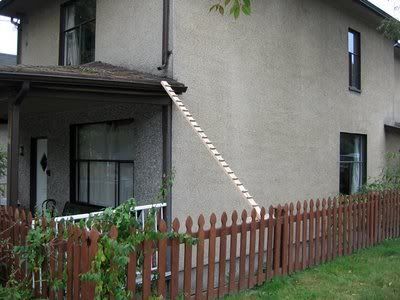
Cat Ladders of the World

You might see constructions like these from time to time and not realize what they are for:


Katt-Trappa is the swedish word for Cat-Ladder. katt-trappa.blogspot.com is a tribute to all the fantastic cat-ladders of the world.
READ MORE - Cat Ladders of the World

"Mafia Birds" Make Others Raise Their Young ... Or Else

Birds can act like gangsters who threaten shopkeepers who fail to pay "protection money," a new study says.

The study focused on the brown-headed cowbird. Females of the species lay eggs in the nests of other bird species, leaving the strangers to incubate and raise the cowbird chicks—or have their nests attacked.

Brown-headed cowbirds "can lay their eggs within ten seconds," said avian ecologist Jeffrey Hoover of the Illinois Natural History Survey, who led the new study. "It's quite amazing how fast they are" compared with other birds.

This cowbird, the main "parasitic" bird species in North America, depends completely on other birds to raise its young—or else.

Cowbird mothers keep watch on the nests where they've laid their eggs.

If the birds find that their eggs have been destroyed or removed from the nest, the cowbirds retaliate, the study says.

The birds reportedly destroy the host birds' eggs, pecking holes in them or carrying them out of the nest and dropping them on the ground.
READ MORE - "Mafia Birds" Make Others Raise Their Young ... Or Else

Wednesday, March 7, 2007

New Weapon Against Warming: "Flatulence Cards" Offset Dog, Human Emissions

While global warming is nothing to laugh at, an Australian company is providing some comic relief, selling carbon credits for flatulent pets and people.

So-called carbon emissions, such as carbon dioxide and methane, are greenhouse gases that are thought to be key factors in climate change. These emissions can be offset by purchasing carbon credits, which may be used to fund environmental programs.

For 35 Australian dollars (about 27 U.S. dollars), customers of Sydney-based Easy Being Green can offset a year's worth of carbon emissions linked to their dogs, from trips to the vet to, yes, breaking wind.

Making your cat carbon neutral for a year costs U.S.$6, while U.S.$16 offsets two years of flatulence from that special someone.

The company says it offsets the climate-warming effects of emissions from cars, planes, humans, and pets by installing energy-saving fluorescent light bulbs and water-saving shower heads in houses in New South Wales, Australia.
READ MORE - New Weapon Against Warming: "Flatulence Cards" Offset Dog, Human Emissions
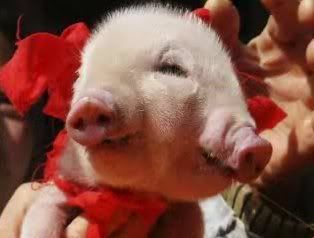
Two-snouted piglet born in China


Two-snouted piglet
March 7 - A double-snouted, three-eyed piglet born was in Northern China.
READ MORE - Two-snouted piglet born in China

Mourners terrified by rampaging ostrich

Its natural reaction would be to stick its head in the sand. But Edgar the ostrich is apparently oblivious to the fact that he is causing quite a flap - by terrorising a rural cemetery.

The rhea bird - a member of the ostrich family - is believed to escape from the animal rescue centre where he lives by squeezing through a gap in the fence or an open gate.

He then bounds half-a-mile along busy country roads to the cemetery in Lostwithiel, Cornwall.

One 77-year-old resident said she had stopped visiting her husband's grave for fear of bumping into Edgar. "I'm simply too frightened - I wouldn't know what to do if I came face to face with it," she said.

"I wouldn't have a chance if it tried to clip me with its feet - they have sharp talons you know."
READ MORE - Mourners terrified by rampaging ostrich

Rare Iranian cheetahs get tracking collars

Scientists said on Thursday they have for the first time collared a pair of Iran's rare cheetahs with tracking systems which they hope will provide invaluable insights into the movements and range of the highly endangered animals.

The Asiatic cheetah once roamed the whole continent but is now confined to the harsh edge of Iran's Kavir Desert. Information on their movements is crucial as there are believed to be only 60 to 100 of the big cats left in the wild.

The two male cheetahs were captured and tranquilized by an international team of scientists in Iran's Bafgh Protected Area, the New York-based Wildlife Conservation Society said in a statement. They were then fitted with Global Positioning System collars.

"This is an amazing milestone in securing the long-term future for the Asiatic cheetah," said Wildlife Conservation Society biologist Dr. Luke Hunter, who led the team.

"We know very little about the important ecological needs of the species in Iran except that they require vast areas ... Understanding their movements as they travel between reserves is one of the first steps in establishing a plan to secure and connect the few remaining populations," he said.

Like its better-known African counterpart, the Asiatic cheetah is a sleek killing machine that can reach speeds of over 60 miles an hour in pursuit of its prey.
READ MORE - Rare Iranian cheetahs get tracking collars

Tuesday, March 6, 2007

Charging moose brings down hovering helicopter

A helicopter is not necessarily a match for an angry moose.

Instead of slowing down after being shot with a tranquilizer dart, a moose charged a hovering helicopter used by a wildlife biologist, damaging the aircraft's tail rotor and forcing it to the ground.

Neither the pilot nor the biologist was injured, but the moose was maimed by the spinning rotor and had to be euthanized, wildlife officials said.

"It just had to be one of those quirky circumstance. Even dealing with bears and goats and moose and wolves, this is pretty unusual and truly a very unique situation," said Doug Larsen, regional supervisor for the Division of Wildlife Conservation.

Biologist Kevin White was aboard the chartered helicopter on Saturday for a study of moose near Gustavus, a community of 459 people about 50 miles northwest of Juneau in southeast Alaska. Moose outnumber humans there 2-to-1, White has written in an essay for the Department of Fish and Game Web site.
READ MORE - Charging moose brings down hovering helicopter