Showing posts with label rodents. Show all posts
Showing posts with label rodents. Show all posts
Monday, May 16, 2011
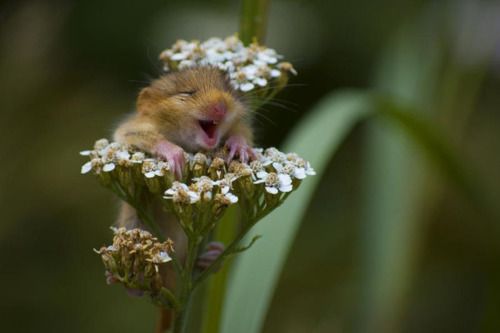

Friday, May 13, 2011
Cute or not? Baby Long-eared bat
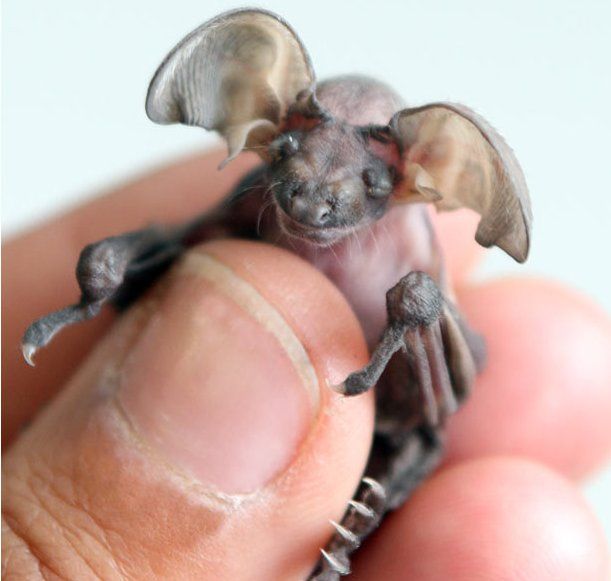
Picture: RICHARD AUSTIN
Monday, March 30, 2009
Friday, February 13, 2009
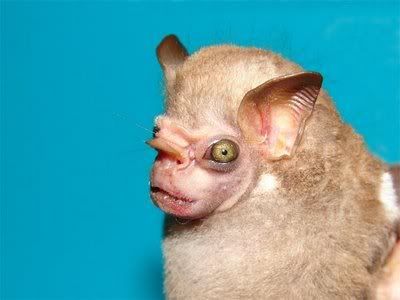
Here's a strange one ...
 It looks a little like a beaver, but doesn't have a paddle tail. It looks like a muskrat, but is way too small. Lacks the webbed feet of a nutria.
So what is it? It's a mountain beaver.
Mountain beavers, (Aplodontia rufa), are not true beavers, despite their name, and they don't always live on mountains. Mountain beavers are the world's most primitive rodent. They have survived relatively unchanged for the past 40,000 years or so, often called a "living fossil."
They are found in limited numbers in the dense underbrush of Pacific Northwest forests, ranging from Northern California to British Columbia.
They like brushy slopes and ravines, particularly those that have been logged or disturbed. And they like dampness, perhaps because their primitive kidneys don't work so well and they need to drink a lot — two-thirds of their body weight daily.
Mountain beavers have damaged an estimated 300,000 acres of commercial coniferous tree species in western Washington and Oregon. The damage period extends to about 20 years after planting. Mountain Beavers cause economic damage by clipping and topping off new seedlings, girdling trees & roots, leading to stunted growth and production losses in forestry plantations.
Found because of a mention at StrangeArk, to an article at The Seattle Times, and more from here. There is a vast amount of information here, including more photos.
Image Source
Thursday, November 20, 2008
Rats! They're back!
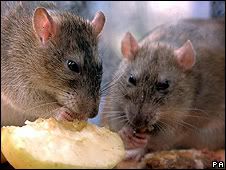 The Pied Piper's services might be needed again in Hamelin, northern Germany - because the rats are back.
An abandoned allotment site on the edge of town has become a haven for rats, with plenty of discarded food and rubbish lying around.
According to legend, in 1284 Hamelin - called Hameln in Germany - was infested with rats but a Pied Piper lured them out of town by playing a pipe.
He later lured the children out too - but the town still celebrates the tale.
Source: BBC
Wednesday, October 29, 2008
Rats in art
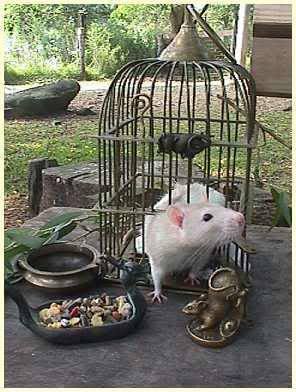 In old Japan, rats had it good because a white rat was a messenger of one of the seven gods of luck, Daikoku. Because of this connection, they were not killed.
The story goes that a rat couple wanted the strongest husband in the world for their daughter. They asked the sun who declined saying that clouds had more power because they could cover him up.
When they asked a cloud, he responded, "The wind is stronger than I because it can blow me away."
The wind could not make the grade either. " The wall stops me cold," he said.
And the wall, though honored by the offer wailed, "The rat is stronger. He can bore a hole right through me."
So the couple wisely gave their daughter in marriage to another rat who was indeed the strongest creature of them all.
-Senryu
More rat stories, rat photos and rat art at: Rats in Art
(via Information Junk)
Saturday, April 12, 2008
Rat wars in India
India's armed forces, which have been battling insurgents in the northeast for over six decades, are now engaged with another enemy - rats.
The rat population in the northeastern states of Mizoram and Manipur - the two states bordering Myanmar - has witnessed a massive growth. With rats destroying crops and devouring grain, the threat of famine looms over the region. Soldiers deployed in the area to fight insurgents are being called in to help the civilian administration tackle the impending crisis.
The explosion in the rat population has been triggered by the flowering of a certain species of bamboo (Melocanna baccifera) that grows mainly in Mizoram but in other neighboring states as well. Thirty percent of Mizoram is covered by wild bamboo forests.
The flowering of this bamboo results in millions of seeds being dropped. Rats devour these seeds. The high protein content of the seeds is believed to either dramatically increase fertility rates among the rats or provide them with the nutrition to enhance survival rates of the entire litter. Litters of over a dozen rats survive and within three months are ready to reproduce themselves. This has resulted in a major rat population explosion.
Some experts say that the rat population in Mizoram is perhaps ten times that of humans in the state.
Source: Asia Times Online
READ MORE - Rat wars in India
The rat population in the northeastern states of Mizoram and Manipur - the two states bordering Myanmar - has witnessed a massive growth. With rats destroying crops and devouring grain, the threat of famine looms over the region. Soldiers deployed in the area to fight insurgents are being called in to help the civilian administration tackle the impending crisis.
The explosion in the rat population has been triggered by the flowering of a certain species of bamboo (Melocanna baccifera) that grows mainly in Mizoram but in other neighboring states as well. Thirty percent of Mizoram is covered by wild bamboo forests.
The flowering of this bamboo results in millions of seeds being dropped. Rats devour these seeds. The high protein content of the seeds is believed to either dramatically increase fertility rates among the rats or provide them with the nutrition to enhance survival rates of the entire litter. Litters of over a dozen rats survive and within three months are ready to reproduce themselves. This has resulted in a major rat population explosion.
Some experts say that the rat population in Mizoram is perhaps ten times that of humans in the state.
Source: Asia Times Online
Thursday, March 27, 2008
An agouti in a blanket
Staff at the Newquay Zoo have been waiting for two years for their only breeding agouti couple to mate.
And the wait finally paid off when the two tiny creatures, which are the smallest of the ten agouti species in the world, were born three weeks ago. They are the first hairy rump - or black-backed - agouti to be born in the UK.

Source: Daily Mail
READ MORE - An agouti in a blanket
And the wait finally paid off when the two tiny creatures, which are the smallest of the ten agouti species in the world, were born three weeks ago. They are the first hairy rump - or black-backed - agouti to be born in the UK.
Source: Daily Mail
Wednesday, March 26, 2008
Cute little Zebra Mouse
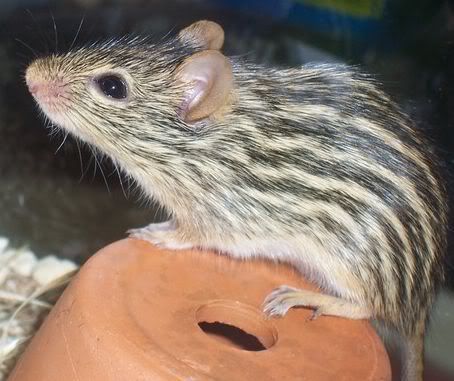 I found this charming little guy at a website, Furry Critters, which is full of information, pictures, and forums about hamsters, rats and mice.
A word of warning about the Picture Gallery: there is just way, way too much to look at there - you might be lost for hours looking at photos.
Thursday, December 13, 2007
Video: Scientists Wowed By Hopping Jerboa
An UPDATE to our September 19, 2007 post about the four-toed jerboa.
The Times Online reports that the jerboa has been filmed in its natural habitat for the first time as part of a project to save it from extinction.
Watch the video on YouTube
A scientific expedition to the Gobi desert in Mongolia has now succeeded in capturing video footage of the nocturnal and little-known animal.
“It’s an extraordinary animal that looks as if it’s been designed by committee - kangaroo legs, snowshoe feet, huge ears and a pig’s nose.
“It represents millions of years of evolutionary history and while it looks like a small rodent it’s very, very distinct. There’s no other animal of its type.”
READ MORE - Video: Scientists Wowed By Hopping Jerboa
The Times Online reports that the jerboa has been filmed in its natural habitat for the first time as part of a project to save it from extinction.
Watch the video on YouTube
A scientific expedition to the Gobi desert in Mongolia has now succeeded in capturing video footage of the nocturnal and little-known animal.
“It’s an extraordinary animal that looks as if it’s been designed by committee - kangaroo legs, snowshoe feet, huge ears and a pig’s nose.
“It represents millions of years of evolutionary history and while it looks like a small rodent it’s very, very distinct. There’s no other animal of its type.”
Wednesday, September 19, 2007
Four-toed jerboa

Four-toed jerboa is a small jumping desert rodent that resembles a rat with rabbit ears and can jump distances of greater than one meter.
Subscribe to:
Comments (Atom)